Let’s be clear from the beginning: there is no established safe way to combine kratom and alcohol. Research has not defined a dose or timing interval that makes the combination predictable.
Alcohol can impair judgment, coordination, and breathing at high levels. Kratom products can have stimulant-like, sedating, or opioid-like effects, and their strength may vary widely. Using them together can make the overall reaction harder to judge.
And the risk may be greater with concentrated extracts or 7-hydroxymitragynine products, heavy drinking, prescription sedatives, opioids, other drugs, or an underlying medical condition. The safest choice is not to mix kratom and alcohol, period.
That being said, we know that people will make decisions to use these substances together, and that some will develop a dependence on one or both. That is where our services can be of help.
At Ingrained Recovery, we assess alcohol use, kratom use, other substances, withdrawal risk, and mental health together. Our medical detox and residential services are appropriate when a person cannot stop safely or has developed a pattern of what is clinically termed polysubstance use.
Essential Takeaways
- Kratom and alcohol can both impair the central nervous system. Their combined effects are not well studied and may be unpredictable.
- There is no reliable “safe waiting period” between taking kratom and drinking alcohol. Product strength, dose, metabolism, and other substances differ too much.
- Kratom and concentrated 7-OH products are not FDA-approved treatments for alcohol withdrawal, alcohol use disorder, pain, anxiety, or another medical condition.
- Poison-center data show that kratom exposures involving multiple substances are more likely to result in hospitalization or serious outcomes than kratom-only reports.
- Alcohol withdrawal can be life threatening for some people. Someone who drinks heavily or has had withdrawal seizures should seek medical guidance rather than trying to replace alcohol with kratom.
Get Accredited Treatment Programs at Ingrained Recovery
What Is Kratom?
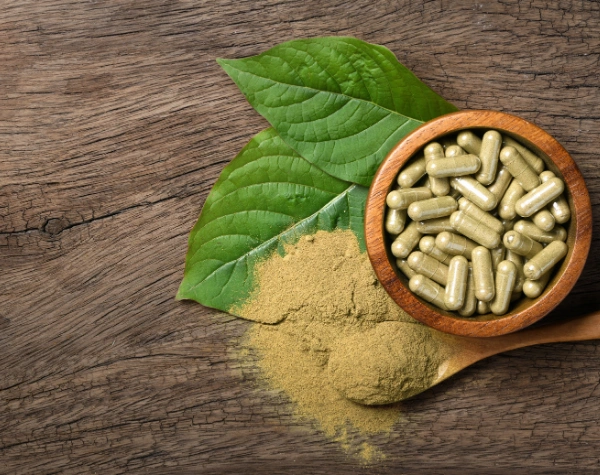
Kratom is the common name for Mitragyna speciosa, a tree native to Southeast Asia. Products made from its leaves are sold as powder, capsules, tea, liquid shots, gummies, tablets, and extracts.
The best-known kratom alkaloids are mitragynine and 7-hydroxymitragynine, often shortened to 7-OH. These compounds interact with opioid receptors, along with other systems in the brain and body. People may report increased energy, alertness, relaxation, pain relief, drowsiness, or euphoria. The response is not reliably determined by a simple low-dose versus high-dose rule.
Kratom products can differ in alkaloid content, concentration, added ingredients, labeling accuracy, and contamination. A traditional leaf powder is not the same as a concentrated extract or a product with added or enhanced 7-OH kratom or pseudo kratom. The label may not provide enough information to predict the effect.
Regular kratom use can lead to tolerance, physical dependence, cravings, and withdrawal symptoms. Legal availability does not mean a product has been proven safe or effective.
Get Proven Detox and Rehab Options at Ingrained
How Kratom and Alcohol May Interact
Alcohol is a central nervous system depressant. It can slow reaction time, reduce coordination, affect judgment, and cause sedation. At high levels, alcohol poisoning can suppress breathing and protective reflexes.
Kratom is more complicated. Some people experience stimulant-like effects, while others experience sedation or opioid-like effects. The same person may respond differently to another product or amount. Combining kratom and alcohol adds uncertainty because both substances can affect alertness, balance, nausea, and decision making.
Potential combined effects include:
- Greater drowsiness or mental slowing
- Dizziness and impaired coordination
- Confusion or poor judgment
- Nausea and vomiting
- Falls, driving injuries, or other accidents
- Difficulty recognizing how intoxicated the person has become
- Breathing problems, especially with high amounts or other depressant drugs
Human research has not established an exact interaction threshold. It would be misleading to say that every episode causes respiratory depression or liver injury. It would also be unsafe to assume that a small amount is harmless.
What are the Short-Term Risks of Mixing Kratom and Alcohol?
Excessive sedation and impaired coordination
Both alcohol and some kratom products can cause drowsiness. A person may have slowed reactions, slurred speech, poor balance, or difficulty staying awake. Even without a medical overdose, this increases the chance of a fall, crash, drowning, or other injury.
Kratom’s stimulant-like effects may also make the experience confusing. Feeling more alert does not mean alcohol impairment has resolved. A person may continue drinking or take more kratom because they underestimate what is already in the body.
Nausea, vomiting, and aspiration
Kratom and alcohol can each cause nausea or vomiting. A heavily sedated person can choke or inhale vomit into the lungs. Someone who is difficult to awaken should not be left alone to “sleep it off.”
Breathing problems and drug overdose
Severe alcohol poisoning can slow breathing. Kratom alkaloids act at opioid receptors, and concentrated products may produce stronger opioid-like effects. The risk is more concerning when opioids, benzodiazepines, sleep medicines, gabapentinoids, or other sedating substances are also involved.
Current evidence does not support a precise prediction for kratom and alcohol alone. Poison-center reports do show that multiple-substance kratom exposures have higher percentages of hospitalization and serious outcomes than single-substance reports. This is one reason to treat any unknown drug combination cautiously.
Anxiety, agitation, and confusion
Not every reaction is purely sedating. Some people experience anxiety, agitation, a fast heart rate, tremors, or confusion. Product variability and individual health make it difficult to know whether the next dose will feel stimulating or sedating, another wild card when it comes to taking kratom and alcohol together.
Who Faces a Higher Risk from Taking Kratom While Drinking?
A serious reaction may be more likely when a person:
- Uses a concentrated kratom extract, shot, tablet, or enhanced 7-OH product
- Drinks heavily or rapidly
- Combines kratom and alcohol with opioids, benzodiazepines, sleep medicines, or other drugs
- Has liver, kidney, breathing, or heart disease
- Has a history of seizures or severe alcohol withdrawal
- Uses several medications that affect the central nervous system
- Does not know what the kratom product contains
- Is pregnant, older, medically frail, or especially sensitive to either substance
- Has already become tolerant and is using higher amounts
A person can still have an adverse effect without any known risk factor. The absence of previous problems does not prove the next combination will be safe.
Kratom, Alcohol, and Liver Damage
Alcohol is a well-established cause of liver injury when use is heavy or prolonged. Kratom has also been linked to uncommon cases of drug-induced liver injury. Reported kratom cases can involve jaundice, dark urine, itching, fatigue, nausea, or upper abdominal discomfort.
Research has not measured how much occasional combined use changes liver risk. It is reasonable to be cautious because both substances are processed by the body and kratom products may contain unknown ingredients. The risk may be higher for someone who already has liver disease, drinks heavily, uses multiple medications, or has had a previous reaction.
Seek medical care for yellow skin or eyes, dark urine, severe abdominal pain, repeated vomiting, unusual confusion, or marked weakness. Do not keep using kratom to test whether the symptoms will pass.
Can Kratom Treat Alcohol Withdrawal or Alcohol Use Disorder?
Again, this point deserves clarity: kratom is not an approved treatment for alcohol withdrawal or alcohol use disorder.
Early laboratory and animal research has explored whether some kratom alkaloids affect alcohol-related behavior, but that is not proof that store-bought kratom is safe or effective for people.
Using kratom to self-manage alcohol withdrawal can create several problems:
- It may delay medical treatment for dangerous withdrawal
- Product strength and contents are uncertain
- Kratom dependence can develop
- Sedation, nausea, or confusion may complicate withdrawal monitoring
- Other drugs or medications may interact
- The person may replace one compulsive pattern with another without treating the underlying alcohol use disorder
Alcohol withdrawal can cause tremors, sweating, anxiety, elevated pulse or blood pressure, vomiting, seizures, or delirium tremens. People who drink heavily, have had withdrawal seizures, or become ill when they stop should be assessed by a medical professional.
Evidence-based alcohol treatment can include behavioral therapy, recovery support, and FDA-approved medications such as naltrexone, acamprosate, or disulfiram when appropriate. Medication selection requires an individual medical evaluation. Kratom should not be used as a substitute for those options.
Dependence, Withdrawal, and Polysubstance Use

A person can become dependent on kratom, alcohol, or both. Warning signs include:
- Needing more to get the desired effect
- Using earlier in the day or more often than planned
- Feeling unable to relax, sleep, or function without a substance
- Repeatedly trying to cut back without success
- Hiding purchases or use
- Continuing despite health, work, financial, or relationship problems
- Using one substance to manage the aftereffects or withdrawal from the other
Kratom withdrawal and 7-OH kratom withdrawal may include muscle aches, restlessness, anxiety, irritability, poor sleep, nausea, diarrhea, sweating, and cravings.
Alcohol withdrawal can overlap with some of these symptoms but can also become life-threatening.
When both substances are used regularly, an assessment should review timing, amounts, product type, other drugs, medications, medical history, and previous withdrawal. A home detox plan based only on internet timelines may miss serious risks.
Why People Mix Kratom and Alcohol
The reason behind combined use matters because treatment needs to address the problem the person is trying to solve.
Common reasons include:
- Seeking stronger relaxation or euphoria
- Trying to offset alcohol’s sedating effects
- Using kratom for a hangover or alcohol withdrawal symptoms
- Drinking to calm anxiety or restlessness after kratom
- Self-treating pain, trauma symptoms, low mood, or poor sleep
- Believing that a natural or legal product is low risk
- Following a routine that has gradually become compulsive
Understanding the reason is not the same as excusing the behavior. It helps the treatment team build safer alternatives for pain, sleep, anxiety, cravings, and social pressure.
What to Do After Mixing Kratom and Alcohol
If the person is awake, breathing normally, and not showing severe symptoms:
- Stop using both substances
- Do not drive, swim, cook, or use machinery
- Do not take more kratom, alcohol, sedatives, or other drugs to “balance” the effects
- Stay with a sober adult who can watch for worsening symptoms
- Keep the kratom package or take a photo of the label
- Contact Poison Control in the United States at 1-800-222-1222 for case-specific guidance
- Arrange medical care if symptoms persist, the product is unknown, or other substances were involved
Do not induce vomiting unless a medical professional tells you to do so. Do not rely on coffee, a cold shower, food, or walking around to reverse intoxication.
When to Seek Emergency Help
Call 911 immediately if a person:
- Cannot be awakened or keeps losing consciousness
- Has slow, irregular, or stopped breathing
- Has blue, gray, or very pale lips or skin
- Has a seizure, collapses, or cannot stand
- Has severe confusion, agitation, or hallucinations
- Has repeated vomiting while very drowsy
- Has chest pain or another rapidly worsening symptom
Place an unconscious but breathing person on their side if you can do so safely, and stay with them until help arrives. Tell emergency clinicians what was taken, when, and how much, if known. Share information about alcohol, prescriptions, supplements, and other drugs.
These emergency steps are separate from addiction treatment. Once the person is medically stable, an assessment can address withdrawal risk and the pattern of use that led to the event.
How Ingrained Treats Kratom and Alcohol Use Together

At Ingrained Recovery, we do not treat kratom use in isolation when alcohol or other substances are also involved. The first step is a review of:
- Kratom product type, amount, and frequency
- Alcohol pattern and last use
- Other drug and medication use
- Previous withdrawal symptoms or seizures
- Physical and mental health conditions
- Prior detox or treatment
- Home environment and recovery supports
Our medical detox program may be appropriate when alcohol withdrawal, kratom withdrawal, or another substance requires monitoring. The recommended approach depends on the assessment. We do not use a single medication protocol for every person.
In residential treatment, clients can take part in individual and group therapy, relapse-prevention work, life-skills practice, and support for co-occurring mental health concerns.
Our kratom rehab program addresses dependence and the needs that may be driving use. Alcohol use disorder and other substance use are included in the same treatment plan when appropriate.
If you have relapsed by taking kratom or 7-OH kratom, our program can often provide support with this substance if there is a medical necessity due to withdrawal symptoms and other factors.
Discharge planning may include outpatient therapy, medical follow-up, peer support, medication management, and a written plan for cravings and high-risk situations.
Continuing care is especially important when a person has used one substance to manage withdrawal or distress from another.
Start a Confidential Conversation at Ingrained
Mixing kratom and alcohol does not have to become a medical crisis before someone asks for help.
Repeated combined use, withdrawal symptoms, escalating amounts, or failed attempts to stop are enough reasons to seek an assessment.
Contact Ingrained Recovery to discuss the pattern of use and learn whether medical detox, residential treatment, or a referral may be appropriate.
Our admissions team can also review insurance benefits and practical next steps confidentially and without obligation, so please reach out today.
Many Forms of Insurance Accepted for Treatment
FAQs About Kratom and Alcohol
Is there a safe way to mix kratom and alcohol?
No safe combination has been established. The strength of kratom products, the amount of alcohol, individual metabolism, medications, and other substances vary. Avoiding the combination is the safest choice.
How long should I wait after taking kratom before drinking alcohol?
Research has not established a reliable safe waiting period. A fixed answer such as 12 or 24 hours may create false reassurance because kratom products and individual responses differ. Do not drink alcohol after kratom based on an internet timing rule.
Does kratom count as an opioid?
Kratom is a plant product, not a prescription opioid. However, mitragynine and 7-OH interact with opioid receptors and can produce opioid-like effects. Concentrated 7-OH products deserve particular caution.
Can occasional mixing cause liver damage?
It is not possible to predict an individual’s liver response from frequency alone. Alcohol can injure the liver, and uncommon kratom-related liver injury has been reported. Existing liver disease, heavy drinking, medications, and unknown product contents may increase concern.
Can kratom help me drink less?
Kratom is not an approved treatment for alcohol use disorder. Animal research does not establish safety or effectiveness in people. A clinician can discuss evidence-based therapy and approved medications that match the person’s health and goals.
How do I know whether I need professional treatment?
Consider an assessment if you cannot cut back, use one substance to manage the other, experience withdrawal, need larger amounts, hide use, or continue despite health and relationship problems. An assessment can recommend the least intensive safe option, which may be outpatient care, detox, residential treatment, or another service.
References
- National Institute on Drug Abuse. Kratom.
- U.S. Food and Drug Administration. FDA and Kratom.
- U.S. Food and Drug Administration. Products Containing 7-OH Can Cause Serious Harm.
- Centers for Disease Control and Prevention. Increases in Kratom-Related Reports to Poison Centers, United States, 2015-2025.
- National Institute on Alcohol Abuse and Alcoholism. Alcohol Use Disorder: From Risk to Diagnosis to Recovery.
- National Institute on Alcohol Abuse and Alcoholism. Treatment for Alcohol Problems: Finding and Getting Help.
- Ahmad, J., Odin, J. A., Hayashi, P. H., and colleagues. Liver Injury Associated With Kratom. Drug and Alcohol Dependence, 2021.
- Das, J. Kratom Alkaloids for the Treatment of Alcohol Use Disorder. Drug and Alcohol Dependence, 2024.
- America’s Poison Centers. Poison Help.