Understanding The Principals of A Higher Power in Alcoholics Anonymous and How to Practice AA Step Two Effectively
Our Step 2 AA worksheet provides guidance for people who understand the words of Step 2 but are unable to apply them in a personal and practical way. Step Two can feel somewhat abstract in theory, which is why we created a Belief Mapping Worksheet to bridge the gap between Alcoholics Anonymous (AA) language and real-life understanding.
At Ingrained Recovery in Eastman, Georgia, we recognize that the Twelve Steps and Twelve Traditions of AA provide practical support to people struggling with alcohol use disorders. We have clients who use AA meetings to supplement their recovery process, while in treatment or as part of an aftercare strategy.
Our AA Step 2 guidance helps you apply the step’s knowledge to your real life. Feel free to download and print these PDF resources as you work on completing this step.
Get Accredited Treatment Programs at Ingrained Recovery

What Step Two Means in the Recovery Process
Some AA members consider Step Two as the beginning point of a spiritual awakening. That’s not because the belief becomes suddenly clear but because openness starts replacing resistance to change. For some people who struggle with alcohol addiction (or other addictive behaviors), the step helps them learn that recovery doesn’t mean willpower alone. Instead, it points to the idea of help beyond the self.
The AA Big Book, the program’s main guidebook, explains that Step Two is about hope. It suggests that seeing such people recover and break free from the trap of addiction can plant the idea that change is possible. This hope is essential when AA members begin imagining a better life in sobriety instead of continuing to live in the isolation of addiction.
Step 2 also prepares AA members for future stepwork by shifting focus away from control and into a place of trust. It doesn’t demand certainty but asks participants to show open-mindedness about change. That becomes the foundation for progressing through the later steps.
Get Proven Detox and Rehab Options at Ingrained

Our 12-Step Worksheet for Practicing Step Two
Here’s the Step Two language:
“We came to believe that a Power greater than ourselves could restore us to sanity.” – AA Big Book
If you’re staring at that sentence, wondering how you can live out these words, you’re not alone. AA doesn’t ask you to force a new belief overnight but to try being open-minded to its spiritual principles.
In AA language, Step 2 eventually connects to a spiritual awakening. You can think of this as a shift in how you think about a Higher Power. This change helps you stop trying to manage your addiction alone and become willing to accept help.
Consider the Step 2 AA worksheet a map. Answer what’s true today so you can find a way to reach your ultimate destination in the future. The process is about learning, developing, and making small changes along the way. As you complete your sheets, remember the AA mantra, “Progress not perfection.”
Section One: What I Believe Today About a Power Greater Than Myself
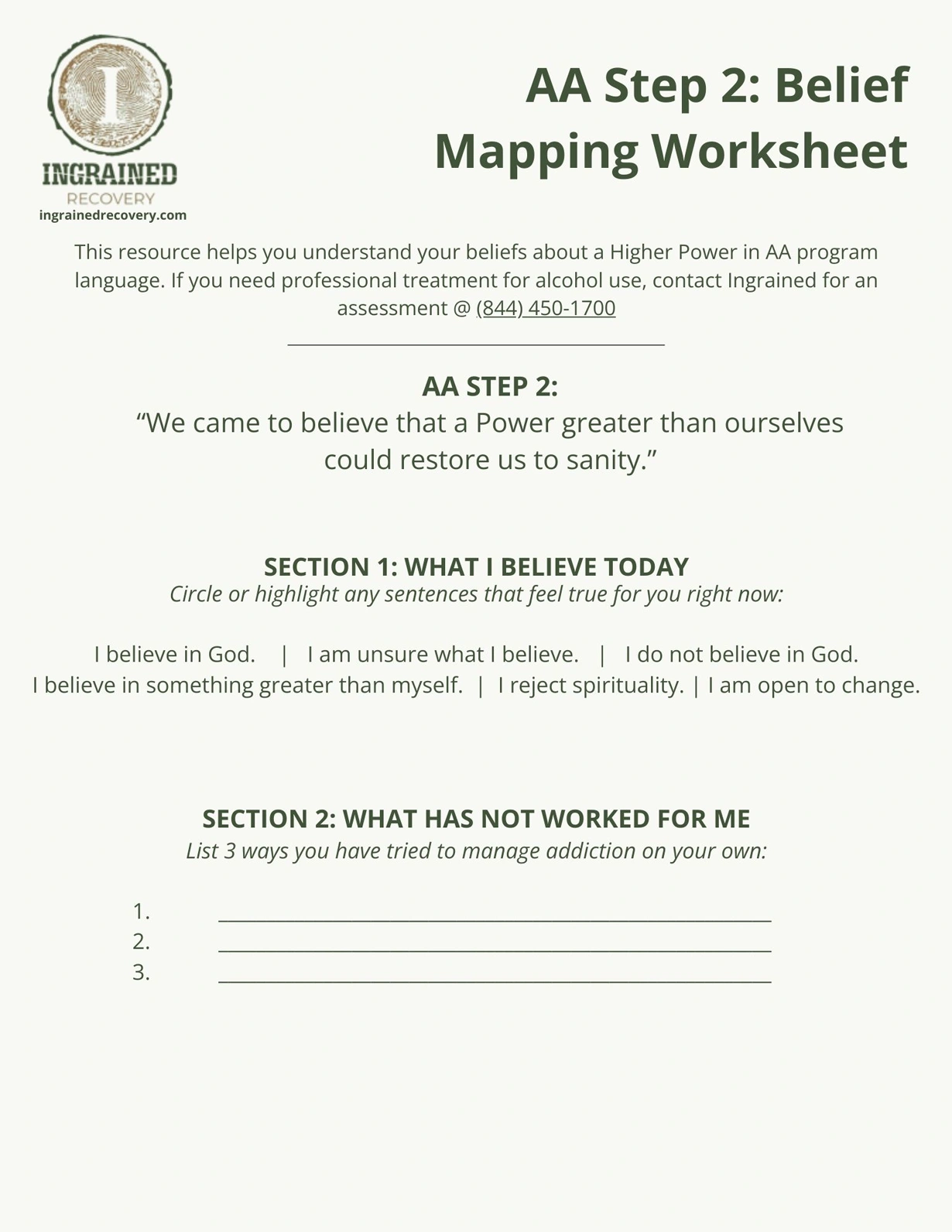
Start by telling the truth. The Step 2 AA worksheet’s first section gives you room to admit your current positioning. You may have a belief in a Higher Power, resist spirituality, or be curious to learn more. Step Two doesn’t ask you for a definition of God or God as we understand Him or Her. It’s okay if your belief is hard to understand or define at this point.
If the spiritual language triggers shame or confusion, note it. Step Two can still work. Many people realize that they don’t know quite what they believe. Still, they can show willingness to believe that a power greater than ourselves might help. That’s a great starting point!
Section Two: Recognizing What Has Not Worked Before
Section Two is important because it’s where hope starts to feel more practical than theoretical. You list your attempts to stop using, not to recount your failures but to find patterns that aren’t worth repeating.
People who have an addiction sometimes try to “solve” their addictive behaviors by using tools that actually keep them stuck firmly in place – hiding, avoiding, minimizing use, or self-isolating. For example, white-knuckling doesn’t work. Use specific examples:
- “I tried to limit my drinking to 1 a day.”
- “I tried to quit alone.”
- “I hid my drinking problem from extended family members for over a decade.”
This section gives you a safe space to focus on what has happened without excuses or self-loathing.
Section Three: Identifying What Feels Bigger Than Me
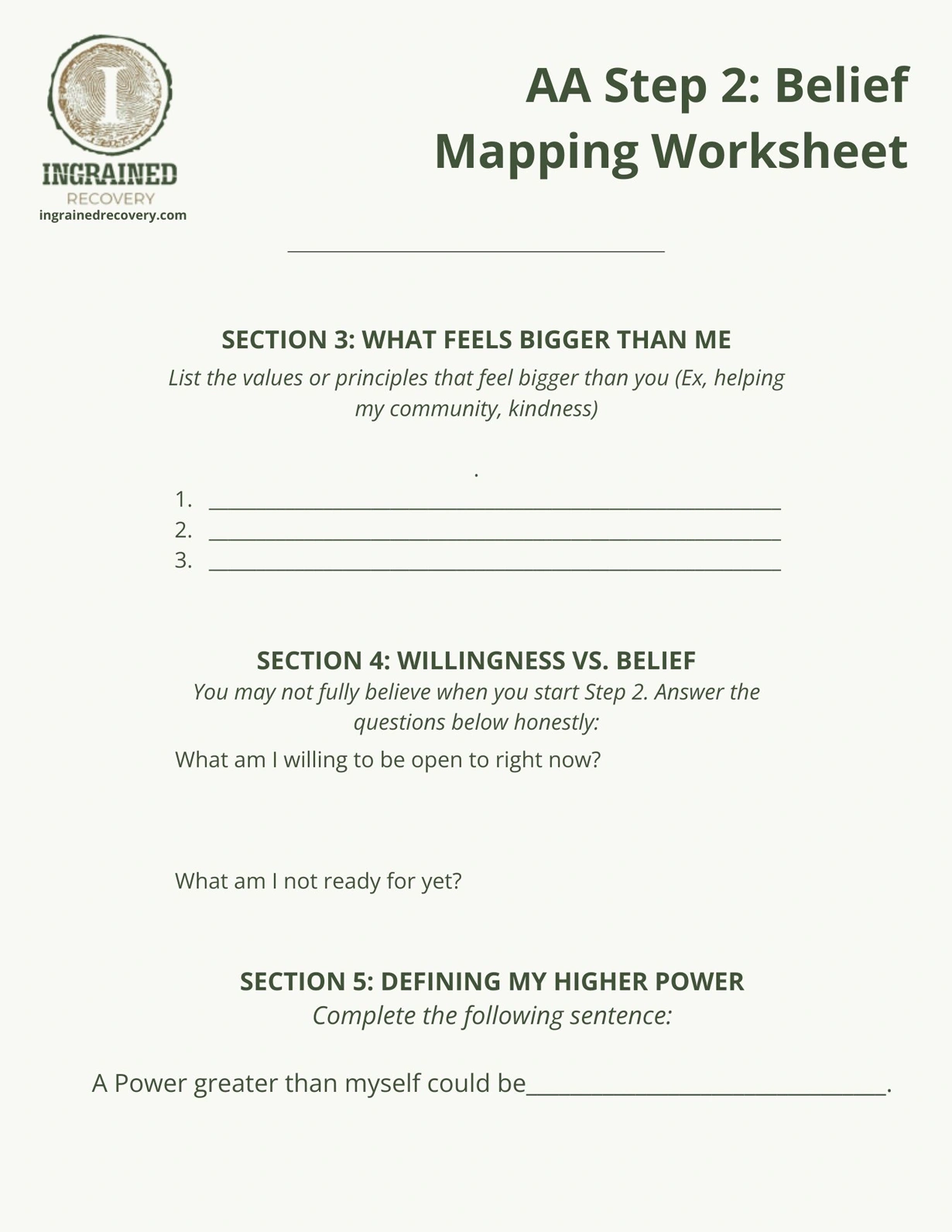
The third section is where the “Higher Power” becomes clearer to many who question the ability to improve our conscious contact with God. “Bigger than me” in the 3rd section can mean many things: truth, love, community, your children, value, or a sense of purpose you hope to regain.
You are seeking something that helps you step out of self-directed survival mode and helps carry you into a better life. You are also building bridges to future steps in the AA program. Keep this simple and focus on direction and not theology.
Section Four: Willingness Versus Belief in Step Two
You may not believe in a Higher Power when you start AA, but that doesn’t disqualify you from the program. Your willingness to try to understand the spiritual beliefs of the program can look, at first, like showing up to meetings, asking questions, or listening to your peers.
The 4th section of our PDF helps you note in what areas you are willing to change and where fear still runs the show. That self-awareness is key to succeeding in future steps.
Section Five: Defining What Could Restore Us to Sanity
The 5th section asks you to write a working definition, which can be spiritual, practical, or something that combines both. “Restore us to sanity” is AA’s way of discussing breaking harmful mental cycles that fuel addiction – rationalizing, bargaining, obsessing, to name a few.
Write a definition for the here and now. It’s okay if you change it in later steps.
“Came to Believe” as the Beginning of Willingness
“Came to believe” is language suggesting aprocess that takes time and assumes eventual growth. It makes room for people who are skeptical or wounded. Some people take weeks to be ready to move on in the healing process, some can take a year or more. Remember that you are not failing if you’re still learning and changing. Keep moving forward and ask yourself, “What would I do today if I believed help was possible?” Then, do one small thing in that direction.
Step Two and Its Role Within the Twelve Steps

Step Two is a cornerstone that helps prepare you for the rest of the Twelve Steps. For instance, it leads into the third step, where you decide to rely on something beyond your control.
After that, the steps get more practical and sometimes challenging. For example:
- Step 4 asks that you take a fearless moral inventory (“list all these defects”).
- Step 5 challenges you to admit the exact nature of your wrongs.
- In Steps 6 and 7, you’ll humbly ask that God remove any defects of character and shortcomings.
- Step 9 means making direct amends to people you harmed during addiction (people wherever possible, except when it would cause harm).
- Step 10 is the start of ongoing maintenance. You’ll take another personal inventory and when wrong, promptly admit it.
- Step 11 asks you to deepen your conscious contact with the Higher Power through prayer and meditation.
- In step 12, you carry the message forward in all our affairs, helping other alcoholics and to practice the principles in your own life.
That’s just a sneak peek – for today, stay focused on Step 2.
Understanding the Phrase 'Believe That a Power Can Help'
This phrase refers to hope that has real power. “Believe that a power greater can help” doesn’t mean you are spiritually confident.
Rather, it suggests that you’re willing to accept that your own efforts alone haven’t improved your daily life. One tip is to replace the word “believe” with “consider” as you start mulling over the notion of a relationship between us and the power.
What Does a Power Greater Mean in Alcoholics Anonymous?

The term “Power Greater” is intentionally open language. Some people pray to God in a traditional sense. Some are open to praying only for knowledge.
What matters here is that your belief system supports honesty and humility. The goal is freedom from addiction.
Greater Than Ourselves Could Mean Something Personal
This phrase, like the others we’ve discussed, is also flexible and allows room for varied human beliefs.
For some, it means trusting God, while others see it as a set of spiritual principles to practice on the hardest days.
Why AA Says ‘Could Restore Us to Sanity’ Instead of Demanding Belief
AA program doesn’t promise “will restore,” it says “could restore,” because Step 2 is an invitation to growth, not a demand.
It’s also worth noting that “sanity” isn’t an insult; it refers to the broken cycle that tells you the lie that you can heal your alcohol addiction without support.
Up To 100% of Rehab Costs Covered By Insurance
Get Support Applying Step Two at Ingrained Recovery Today
Don’t let Step Two cause stress or anxiety. Be honest; that’s where recovery starts. If you’re stuck in one spot, you might need the support of a treatment professional, as you’ll find at Ingrained Recovery.
Our compassionate, licensed mental health professionals can guide you through the recovery process with individualized, evidence-based treatment plans.
Please reach out to our admissions team today with any questions you have about Alcoholic Anonymous or recovery. All calls are confidential, so please reach out for our compassionate support now.