Addiction Treatment Programs for Couples Using CBT
If you’ve found this page to learn more about Cognitive Behavioral Couples Therapy for addiction treatment, you probably already know that addiction doesn’t affect just one partner in a relationship.
Addiction leads to negative patterns of behavior and emotional distress for both people. It can trigger relationship distress ranging from negative exchanges to domestic violence.
Even once solid intimate relationships can crack under the pressure of substance abuse disorders, even after achieving sobriety. At Ingrained Recovery in Eastman, Georgia, our therapists assist couples who hope to put the pieces of their relationship back together after addiction.
We encourage you to keep reading to learn about how our Cognitive Behavioral Couples Therapy (CBCT) and other evidence-based treatments can help you sort through the negative emotions and overcome relationship distress caused by addiction.
Get Accredited Treatment Programs at Ingrained Recovery
Understanding Cognitive Behavioral Couples Therapy for Addiction Treatment
CBCT principles focus on what you are doing together that either supports recovery or keeps addiction alive. Addiction changes how partners think, speak, and react. Over time, those reactions turn into predictable patterns.
CBCT helps you identify those patterns and change them by taking a contextual approach to the problems within the relationship. Research findings from randomized controlled trials published in the Journal of Substance Abuse Treatment and various meta-analyses show that couple-based interventions improve both sobriety and relationship stability.
What does that mean to you? When you address the relationship alongside the addiction, outcomes consistently improve.
Get Proven Detox and Rehab Options at Ingrained

Addiction Impacts Both Partners: Even if Both Are Not Drinking or Using Drugs
Addiction creates relational distress long before a couple Googles to find help. Conversations grow tense. Emotional responses become more intense. Trust weakens. It is an overwhelming emotional experience.
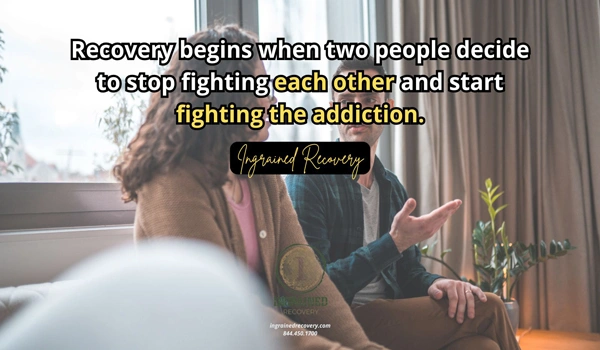
Social learning theories explain how couples unintentionally reinforce destructive behavior. One partner withdraws. The other pushes harder. Resentment continues growing. These cycles don’t break on their own. CBCT increases self-awareness so you can see what is happening in real time. Once you recognize the pattern, you start restructuring interactions to support recovery instead of sabotaging it.
When Both Partners Struggle With Substance Use
When both partners use substances, the risk multiplies. Shared triggers, shared environments, and shared habits make sobriety harder. Individual problems quickly become relationship problems.
Substance use often overlaps with anxiety disorders, depression, and other psychological disorders. Untreated individual psychopathology increases relapse risk. In inpatient treatment, clinicians stabilize both partners while strengthening the relationship at the same time.
Restructuring Interactions. Emotional Responses, and Breaking the Cycle De Escalation
Addiction intensifies emotional responses. Small conflicts feel overwhelming. Primary emotions like fear or shame hide beneath anger.
The cycle de escalation process teaches couples how to slow those reactive exchanges before they spiral. Instead of attacking or withdrawing, you learn to pause, identify what you’re actually feeling, and respond with intention.
Attachment theory and insights from social neuroscience show that when couples feel emotionally safe, they regulate stress more effectively. As you build a more secure bond, conflict loses its power to trigger relapse.
Communication, Problem Solving, and Rebuilding Trust

Addiction damages communication, leading to secrecy and distance.
Through structured communication training, you learn how to speak directly without escalating conflict. You practice practical problem-solving skills to find solutions to deal with everyday issues like finances, boundaries, parenting, and daily stress without turning on each other.
As dyadic coping improves, social support within the relationship strengthens. Consistent follow-ups and accountability are key in rebuilding trust over time. Positive effects extend beyond sobriety into overall relationship stability.
Integrative Behavioral Couple's Therapy Within CBCT
Traditional CBCT focuses on behavior change. Integrative behavioral couple therapy expands that work by helping couples accept vulnerability instead of fighting it.
Emotion-focused couple therapy (EFCT) and similar approaches dig deeply into attachment wounds. Emotionally focused therapy helps you recognize how unmet needs drive reactivity. Both approaches help couples to better understand and cope with their presenting concerns. They also both have a goal of improving communication skills and problem-solving in couples therapy. These methods are well-documented in multiple clinical handbooks and continue to evolve with new advances.
Contemporary family therapy models increasingly blend cognitive behavioral structure with emotionally focused insight. This balanced approach reflects recent advances in treatment and current opinion within clinical psychology. You change behavior, and you strengthen emotional safety at the same time.
The Role of Family Therapy in Recovery Stability
Family therapy can reinforce progress made in couples treatment. When appropriate, involving trusted family members increases accountability and broadens social support.
Addiction affects the entire family ecosystem. Healthy support systems improve long-term stability and reduce relapse risk.
Physical Health and Co-Occurring Mental Health Problems
Substance use takes a toll on physical health. Sleep disruption, stress overload, and other health problems complicate recovery.
Comprehensive inpatient care allows clinicians to stabilize both mental and physical health while addressing co-occurring psychological disorders. Treating the whole person increases the likelihood of lasting change.
Preparing for Life After Addiction Treatment Together

Recovery doesn’t end at discharge. You leave treatment with tools to manage stress, regulate emotional responses, and maintain healthier patterns.
CBCT changes you and your partner. It brings greater self-awareness, challenges irrational assumptions, and helps you build new feelings of stability inside the relationship.
When you learn how to solve problems and respond appropriately instead of reacting to internal factors. Mastering cognitive restructuring tools allos you to protect both your sobriety and your partnership.
Many Forms of Insurance Accepted for Treatment
Find a Setting to Support Recovery Together at Ingrained
Many couples need professional support for the relationship problems and marital distress that arise from addiction. CBCT interventions are effective at helping couples process and change the resentment or bad feelings that remain, even after recovery.
If you have a partner in recovery, the relationship issues won’t suddenly disappear. Our team can guide you in structured therapy sessions to restore relationship satisfaction.
Call our admissions team today to learn how we can help support you in healing. All calls are confidential, so please reach out now for our assistance.
References Cited
- O’Farrell, T. J., & Clements, K. (2012). Behavioral couples therapy for substance abuse and relationship problems. Journal of Clinical Psychology, 68(5), 514–525.
- O’Farrell, T. J., & Clements, K. (2012). Behavioral couples therapy for alcoholism and drug abuse. Journal of Marital and Family Therapy, 38(1), 122–144.
- McCrady, B. S., Epstein, E. E., Cook, S., Jensen, N. K., & Hildebrandt, T. (2009). A randomized trial of individual and couple behavioral alcohol treatment for women. Journal of Consulting and Clinical Psychology, 77(2), 243–256.
- Wiebe, S. A., Johnson, S. M., & Lafontaine, M.-F. (2022). Emotionally focused couple therapy: Attachment science in practice. Journal of Clinical Psychology, 78(9), 1762–1775.