Finding Sober Living and Recovery Residences in Atlanta
Finding sober living in Atlanta involves more than choosing a neighborhood. Compare the support offered, house policies, costs and access to the care and daily activities you need. Recovery housing can offer a shared environment focused on recovery, while clinical treatment may be provided separately.
We offer medical detox and residential treatment for adults at our 50-acre Eastman, Georgia campus. If sober living near Atlanta is part of your next-step plan, ask our team about referrals and how to check your options. We do not guarantee placement or operate an Atlanta sober-living home.
This guide covers certification, support levels, house rules, transportation and local career resources so you can ask practical questions before committing to a residence.
Explore Our Treatment Options

How Recovery Housing Can Fit Your Plan
As you plan a move from residential care, discuss what housing and ongoing clinical support you will need. A recovery residence may fit some people’s goals; others may need a different living arrangement or level of care.
The Georgia Association of Recovery Residences (GARR) provides certification information and a member directory. Confirm a particular residence’s current status directly with GARR and the operator before making arrangements. Our team can discuss referrals, while the residence makes its own admission and availability decisions.
Checking GARR Certification and House Standards
GARR uses National Alliance for Recovery Residences standards as its framework for certifying recovery residences in Georgia (Georgia Association of Recovery Residences, n.d.). Certification gives you a set of standards to ask about; it does not replace checking whether a particular home meets your needs.
Ask about current certification, staffing, resident rights, grievance procedures, medication policies and the response to a return to substance use. Visit or request a conversation with the operator when possible. Avoid assuming that membership alone guarantees a particular experience or outcome.
Commitment to Ongoing Recovery and Life Skills Development
House rules and daily schedules differ. Ask for the written policies before you pay a deposit or move in. Topics to cover include:
- House meetings, shared responsibilities and expectations for daily routines.
- Drug and alcohol testing, prohibited substances and the response to a positive result.
- Curfews, visitors, work schedules and time away from the home.
- Expectations for mutual-help meetings or outpatient appointments.
- Storage and use of prescribed medicines, including medication for opioid use disorder.
Discuss any conflict between house rules and your clinical needs with your prescriber and the operator. Our life-skills information also covers routines and practical goals you may want to plan for.

Balancing Peer Support and Independent Living
Your housing plan should support the care recommended for you. Ask how you would attend appointments, obtain prescribed medication, participate in recovery support and manage work or family responsibilities.
If you are interested in complementary activities during clinical treatment, you can review our equine-therapy coverage guide and discuss suitability and costs with our team. These activities are separate from the residence’s housing services, and availability should be confirmed.
NARR describes four support levels: peer-run, monitored, supervised and clinical. These levels describe differences in staffing, governance and services; they are not rankings of how “good” a home is (National Alliance for Recovery Residences, n.d.).
Choose the level that fits your needs. Ask who is onsite, when help is available and whether clinical care is provided within the program or through another organization. Confirm the arrangements for any treatment you need, rather than assuming every sober-living home includes counseling or medical services.
Medical Detox and Residential Care
Questions to Consider Before Choosing Sober Living
A recovery residence can offer shared routines and peer support, but the right choice depends on your circumstances. Consider your clinical plan, housing stability, work or education, budget and the people you want nearby.
Compare more than one home when possible. Ask our team to help you identify the questions that matter for your return to Atlanta, and confirm details with each operator.
House Policies and Recovery Support
When comparing sober living in Georgia, ask how each home supports day-to-day recovery and responds when a resident needs more help. Written testing, medication and return-to-use policies are particularly useful to review.
Plan how you would contact your clinician, attend follow-up care and reach supportive people. A house’s no-use policy alone does not tell you how it will help with a difficult period or arrange a higher level of care when needed.
Continued Access to Recovery Resources
Continuing care is individual. Discuss whether you need counseling, medication follow-up, outpatient treatment, mutual-help meetings or some combination of supports after residential treatment.
You can use the official AA finder, NA finder and SMART Recovery meeting finder to explore current options. Check schedules, participation rules and transportation before choosing a home.
If PHP or IOP is recommended, confirm the receiving provider’s acceptance, schedule, insurance and costs directly. Living near a program does not guarantee admission or transport.
Transition to Independent Living When Ready
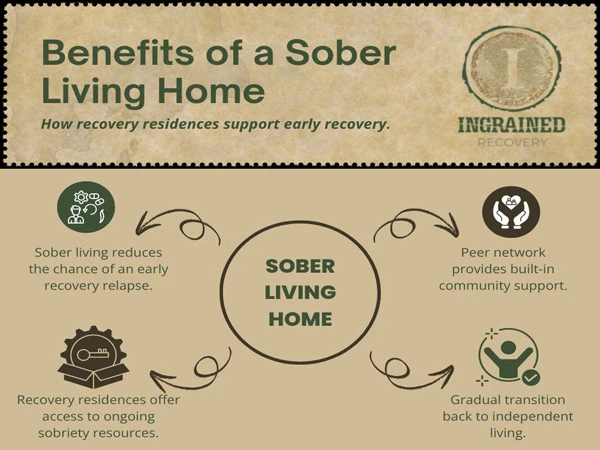
Sober living can provide time to practice daily routines between residential treatment and independent housing. Discuss the goals you would work toward and how the operator supports increasing independence.
- Employment, job training or education that fits your care schedule.
- Counseling, medication follow-up and recovery meetings as appropriate.
- Budgeting, rent and other household responsibilities.
- Supportive relationships and plans for time with family or friends.
- Future housing and the steps needed to move safely.
Review progress with your care team and the residence. The right timing for a move depends on your needs and resources.
A Strong Sense of Community Support

A shared home offers opportunities to meet people working on recovery and exchange encouragement. Ask how residents take part in decisions, resolve disagreements and seek help with concerns.
Personal boundaries and compatibility matter too. Consider the household’s routines, accessibility, privacy and expectations for participation. A supportive community should make room for your individual needs and clinical plan.
Find Educational or Career-Enhancing Opportunities
Goodwill of North Georgia offers free career services, including Career Connector online, job-search resources and help preparing for employment (Goodwill of North Georgia, n.d.).
For historical context, Goodwill reported 22,113 job placements and 43,146 people served in fiscal year 2023 across its North Georgia service area (Goodwill of North Georgia, 2025). These are organization-wide figures, not outcomes for Atlanta sober-living residents or promises of a job.
Check current career-center and online options, eligibility for particular training, and how participation would fit your treatment and housing schedule.
Recommit to Getting Fit
Walking, stretching or another activity you enjoy may be a practical part of your daily routine when appropriate for your health. Ask about nearby parks, accessible spaces and any fitness facilities the residence actually provides.
Choose activities that fit your physical needs and care plan. Discuss restrictions or concerns with your healthcare professional rather than assuming that a particular exercise program is suitable for everyone.
Discuss Insurance and Treatment Costs
Contact Admissions at Ingrained Recovery
We provide medical detox and residential treatment for adults at our Eastman, Georgia campus. Call 844-450-1700 to discuss your needs, clinical suitability, availability and plan-specific insurance questions.
If you need outpatient care or recovery housing near home, ask us about referrals and confirm the receiving provider’s services, eligibility, availability and costs directly.
Before leaving home, confirm clinical acceptance, current availability, expected costs and your arrival arrangements with our admissions team. Use a current map for your route to Eastman; travel times vary with your starting point, route and traffic.
References
Georgia Association of Recovery Residences (n.d.). Standards. Retrieved October 26, 2026, from https://www.thegarrnetwork.org/standards-extended
Goodwill of North Georgia (n.d.). Explore our career centers. Retrieved October 26, 2026, from https://www.goodwillng.org/putting-people-to-work/explore-our-career-centers/
Goodwill of North Georgia (2025, December 31). Goodwill of North Georgia kicks off “New Year, New Job” with Skyhawks partnership and career fair series across the region. https://goodwillng.org/news/goodwill-of-north-georgia-kicks-off-new-year-new-job-with-skyhawks-partnership-and-career-fair-series-across-the-region/
National Alliance for Recovery Residences (n.d.). Standards. Retrieved October 26, 2026, from https://narronline.org/standards/